Survivor: Zoom Rockman on Telling a Holocaust Story for a New Generation
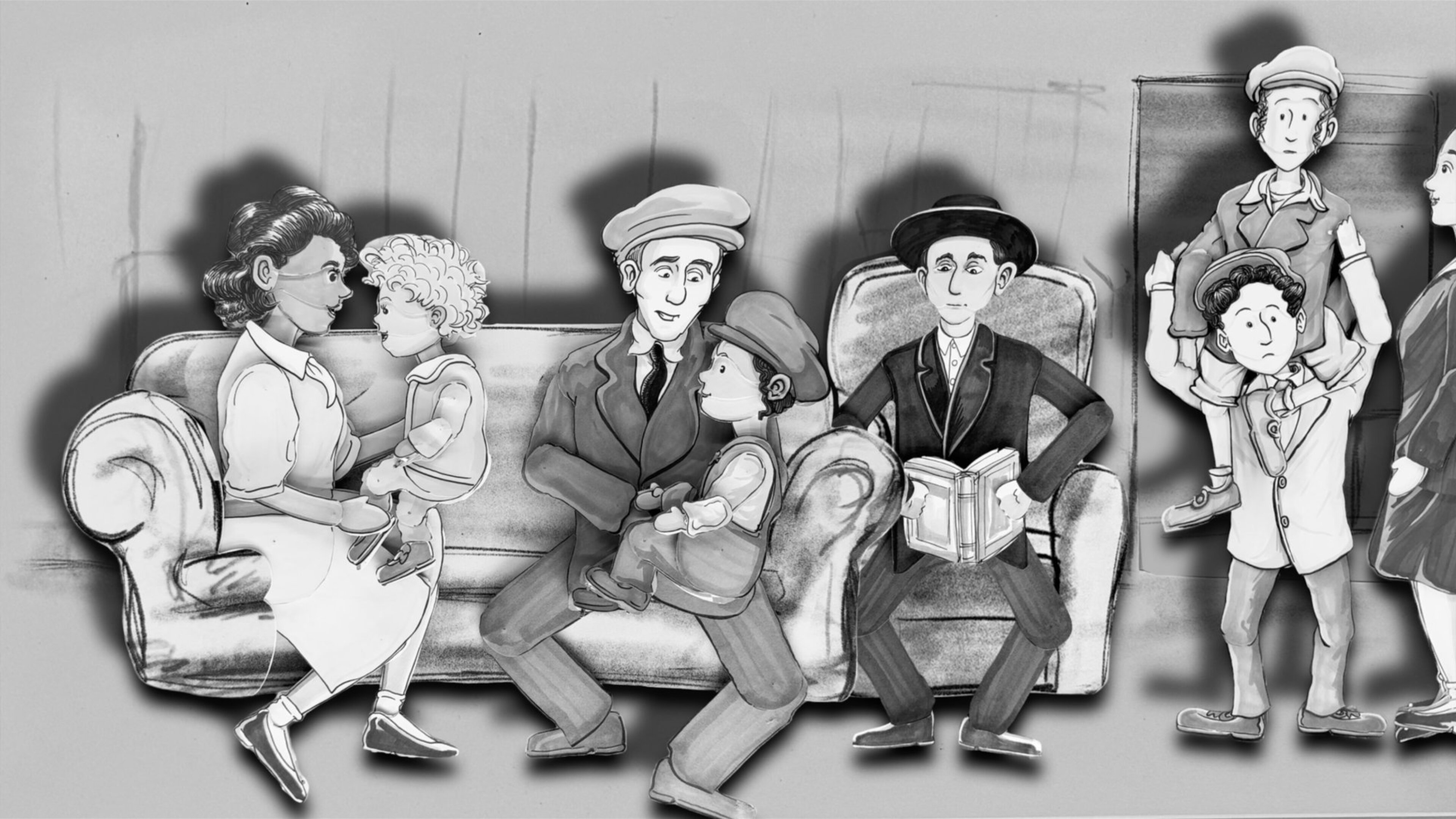
In honor of International Holocaust Remembrance Day, we sat down with filmmaker and artist Zoom Rockman to discuss his first feature-length film, Survivor: The True Story of Ivor Perl. In this conversation, Rockman reflects on adapting a true story of survival to the screen, the responsibility of re-telling survivor testimony, and why animation became the medium through which this story could reach a new generation.
Survivor is now streaming on ChaiFlicks in the United States, Canada, the United Kingdom, and New Zealand.
Bringing a Holocaust Testimony to the Screen
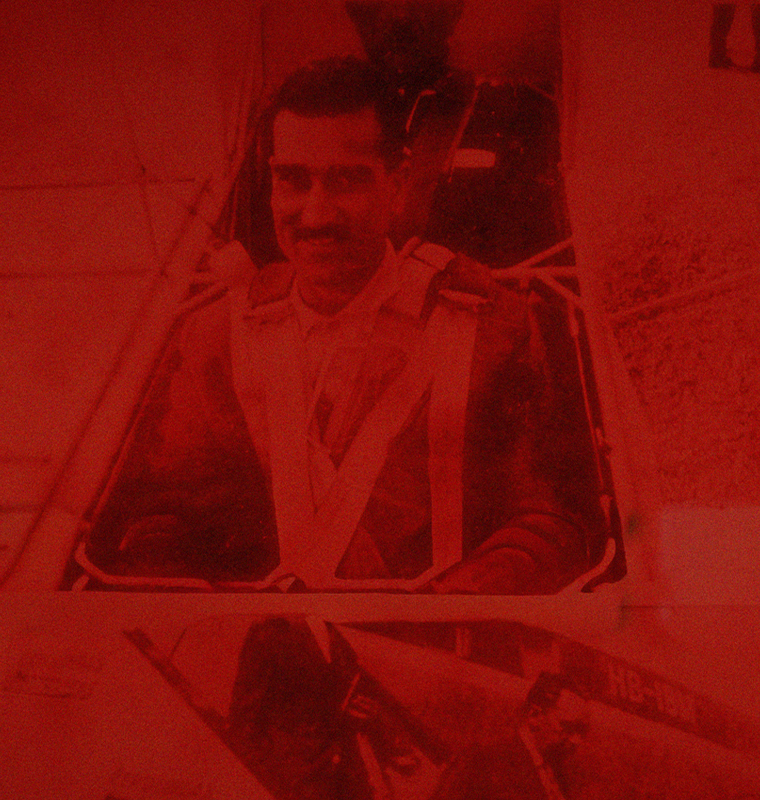
Survivor is based on the true story of Holocaust survivor Ivor Perl. Perl was born in Hungary in 1932, and was only 12 years old when he was deported to the infamous Auschwitz-Birkenau concentration camp. Out of a family of nine, Ivor and his older brother Alec are the only ones to have survived the camps. After the war, Ivor and Alec spent some time in the displaced persons camp before gaining passage to the UK, where Ivor has made his life. Thankfully, Ivor is still going strong at 94 years old, living in London.
Q: Zoom, you're a London-based, award-winning political cartoonist, illustrator, and filmmaker, and Survivor: The True Story of Ivor Perl is your first feature-length film. That's quite a selection for your first feature film. Can you tell us where the idea for the film came from and why you chose this particular story?
I think the beginning of it all started in summer of 2023. I've been working as a cartoonist since I was 8 years old. I had an exhibition in London at a place called JW3, which is the Jewish arts and cultural center here. It was called Zoom Rockman's Jewish Hall of Fame, and it was portraits I'd done of Jewish celebrities who were British and international ones as well.
They organized for Holocaust survivors from the Survivor Center in London to come and visit my exhibition. And a group of them came, and I was kind of faced with this dilemma that I'd drawn all these portraits of celebrities. But then I was meeting these incredible people, and I actually felt that maybe these people were more deserving of portraits of them... And that's where I met Ivor Perl for the very first time.
A lot of these survivors who were on this little tour group came from the Kindertransport, so they'd escaped pre-Holocaust, managed to get out of Europe. And I assumed Ivor was part of this group, but actually, I'd been given a copy of his testimony. On October 7th, I sat down and I read Ivor's book, called Chicken Soup Under the Tree, and found out that he'd been in Auschwitz, Dachau, all of these camps. I was very surprised. And also the way he wrote was very visual as well.
As a Jewish Londoner born in 2000, I was always told I was the last generation to meet survivors, but I'd also grown up with the internet my whole life. I'd seen the rise of Holocaust denial online. And this thing that when the Holocaust happened, it was the older generation that didn't believe it and the younger generation that did. And now, with all the disinformation that exists, it's actually the opposite.
Q: Why did you choose animation as the medium for telling this story?
ZR: Animation allows you to show more than live action ever could, without censoring the truth. There's a paradox where animation actually lowers people's guard, but it makes the experience more real at the same time. You can depict things that would be too graphic or disturbing in live action, but in animation, you can show the truth while still making it accessible. I wanted to create something that would present a primary source testimony in a way that would engage my generation—both Jewish and non-Jewish audiences.
Q: Can you talk about the research and sources that informed the film beyond Ivor's testimony?
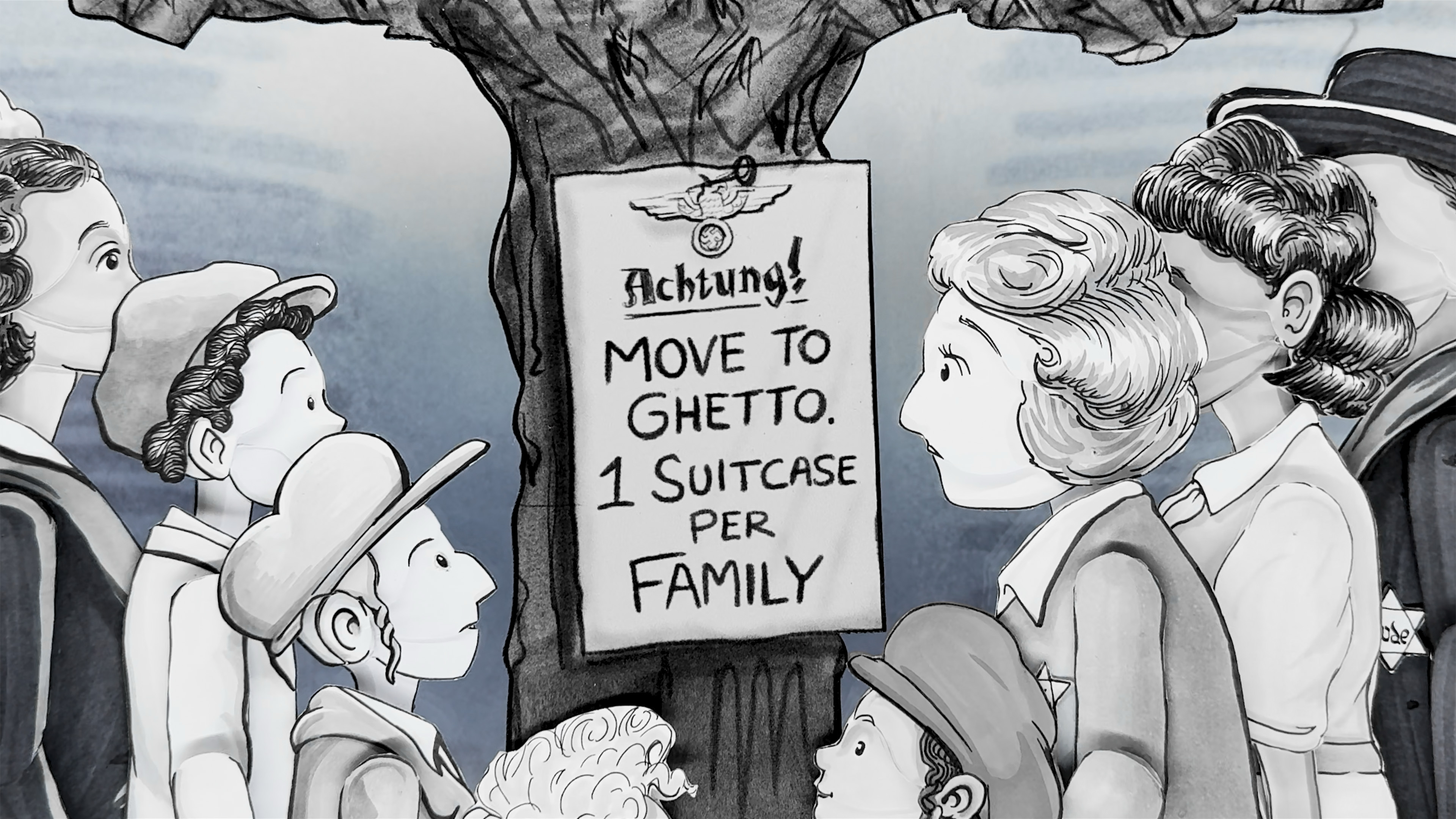
Everything in the film, even though it's animation, is based on something that actually happened. It's all true story, true characters. Even down to the dialog — when I was speaking with [editor] Katie about the dialog in the film, there's like 90% of that is directly from Ivor's testimony. There was no dramatic rewriting of dialog just for the sake of having that in there.
The film is almost like it's packaging together a lot of sources of information. I was looking at sketchbooks of prisoners, testimonies of Elie Wiesel and Primo Levi, the rich source of photography of these people. I wanted to present the film not as telling people what to think, but presenting it as a rich source of factual information.
Q: You mentioned working with Aaron Baron-Cohen on the music. How did you approach the score for this film?
I think musically there's the trope of violin music and things like this. And I think sometimes music like this can actually take you out of the experience, or it gives you somewhere nice to go when something terrible is on screen. Working with Aaron Baron-Cohen on the music, I was talking about having an industrial, very sharp and electronic music for those sections of the film. I thought that was very important.
Aaron made this suite of music for the film called Survivor's Suite, and it went through different stages, and I was able to intersperse it. But I've also got a friend called Pini Brown who's trained as a cantor in Jerusalem. And there was a scene in the film which had a cantor in it, and I was like, I know you can do this.
And what's strange is in the film, the guy is called Moishe Kraus — he's the cantor that I based it on — and I told my friend Pini this, and he said, oh, I've met him when I was younger. He was my teacher's teacher.
Q: What has the response been like, especially from younger audiences?
In the context of the times we're living in, it's just incredible that you're able to reach people younger than us, and much younger than a lot of, for example, the books and obviously the academics and the feature films. Most forms of telling the stories of the Holocaust are aiming at much older and often more educated audiences, so it's incredibly important that a film like this exists.
Part of it is identifying what tropes existed in the genre already and trying not to do the same thing, just because I thought maybe these things weren't as effective today with this generation as previous ones might be. As I said, growing up with the internet, people do their research. There's a lot of misinformation out there, but they're not really following the news in the same way that the older generation did.
Q: What do you hope audiences take away from this film?
I wanted to show where hatred brings a society, and that love will always get you further than hate. There's so many moments in the film that while watching it, you think, I cannot believe this actually happened to this person, and he's here to tell us about it. That's why it's so important to continue telling these stories.
Q: Thank you again for allowing us to present it to our audience at ChaiFlicks.
Thanks for having me. And thanks for hosting the film.
Survivor: The True Story of Ivor Perl is now available to stream on ChaiFlicks. in commemoration of International Holocaust Remembrance Day.